Wednesday, June 10, 2009

A you might be list

In light of the closure of a recent bad employment experience, I thought I'd write a humorous account of my misadventures in the form of a "You might be..." Jeff Foxworthy type list.  So, here it is.  You might be working for an idiot if:

  1. Your boss can't spell your name on official documents, despite having multiple printed copies of your name on other documents and your name being only three letters long. (How you get "Qua" from "Kuo" is still beyond me)
  2. Your boss claims that you should work through dinner because we're dealing with Eastern European programmers on a different time schedule than us.  I may not be a math genius, but adding 5-7 hours on to 7ish p.m. Eastern Standard Time seems to put the Europeans in the midnight and beyond range.  Perhaps they really are all vampires over there.
  3. Your boss wants you to write code testing for a number greater than 10 to subsequently execute code testing whether that same number is less than 10.  Logic may have been my weakest standardized test score, but I have trouble seeing how it's mathematically possible for a number to be simultaneously greater than and less than 10.  (I was going to insert a statistician joke here, but thought better of it)
  4. Your boss gives you the above logic-confounding instruction on three separate occasions in a 2 week time frame.
  5. Your boss has been known to call technical support for a company and demand that the outsourced low level support employee log on to his system and tell him why his code isn't working with their software.
  6. Your boss thinks it's a good idea to do Flash animation over the network work by remotely logging into his system, even though you can only see the animations at a 1-2 frame per second refresh rate.
  7. He thinks its a good idea to do the above over a trans-Atlantic internet connection.
  8. Your boss doesn't understand why people can't move around the screen as quickly as he can on his local PC when they're remotely logged into his computer over the internet and he's running a higher resolution than everyone else.
  9. Your boss (the multitasking guru) thinks it's a good idea to tell you to actively train another developer while simultaneously working on another section of code.  Apparently, doing two incongruous tasks which both require active participation must double your effectiveness when done together.  I'll remember that next time I'm texting, watching t.v. and driving.
  10. Your boss tells you that you can't eat lunch because work needs to get done... a mere hour after he eats his lunch in front of you.
  11. Your boss tells you there's something medically wrong with you for needing to eat so often... after he eats his lunch in front of you. (this was the final straw in my quitting decision)
  12. Your boss constantly spouts off how he's been doing software engineering for over 25 years... yet he doesn't know anything about programming.
  13. Your boss, the esteemed software expert, refuses to use version control software on a huge, convoluted code base.  Apparently, using industry standard computer software to manage rote, bookkeeping, time-consuming code tasks "develops bad habits." It's a task better handled old school: by error prone humans who don't always remember every little record-keeping step.
  14. Your boss continually refers to his software as being written in .NET, when none of his code is written in .NET.
  15. Your boss develops software for the education market... and claims that no one in the education market uses a Mac.
  16. Your boss, who is developing on a strictly Microsoft platform, thinks it's a better idea to use his own development tools to write and manage code rather than using the Microsoft Visual Studio IDE.  Apparently, his tools developed in the early 90s work better than highly integrated GUI tools of today.  Code folding, code highlighting, pop up function prototypes, easy code navigation and searching, etc. are all features which pale in comparison to deprecated, crash prone, PC Junior-like development software.
  17. Your boss can't even do problems in the children's math tutorial lessons he himself designed.  It took superhuman effort not to bust a gut when he was doing the problems with some young children and got flummoxed by his own tutorial.

Tuesday, June 9, 2009

Trials and Triumphs

Yesterday, I had the thoroughly unpleasant experience of going to court.  I had to sue my former employer for backpay.  The period leading up to the hearing was a nerve-wracking experience, but in the end, it felt like a huge relief to air my grievances in a court of law.  I won't know the judge's decision for a few days, and even if my suit is successful, I may not be able to collect anything.  But that really doesn't matter to me.  The court hearing feels like a moment of closure.  After many months, I feel like I can put the whole unpleasant experience with my former employer behind me.

In every bad situation, there's still a positive spin.  You might argue that people that put those positive spins on bad situations are annoying overly perky people, but after talking to friends and family, I feel that there were at least a few good things that came out of the trials of my last employer's douche-baggery.  If I hadn't taken that horrid job:

  1. Gen and I probably wouldn't have gotten married as soon as we did, and we probably would have splurged an inordinate amount of cash on a large, fancy wedding instead of going to much cheaper and less stressful route of eloping.
  2. I wouldn't have seen first hand the various lessons of mismanagement.  I got hands on experience with exactly how a company should not be run.  Call it learning by examples of what not to do.
  3. I wouldn't have built up my patience and breathing meditation practice from having to deal with an incompetent moron every day.
  4. I wouldn't have been so immensely successful at dropping my weight because I wasn't actually given any time to eat regularly (meals, snacks, or otherwise).
  5. I may not have learned interesting Chinese phrases (like "Win or lose, no heavy heart") from my mom and thus not made any progress on expanding my vocabulary beyond "I had stir fry for dinner."  As a bonus, my dad stopped spouting useless, completely imaginary phrases at me like "the early spring chicken gets his groove on."
  6. I wouldn't have gained as much proficiency in assimilating information for spotting inconsistencies and untruths.
  7. I wouldn't have seen the fascinating aspects of the legal system.  Believe it or not, not everything about the legal system is dry, boring, and unpleasant.  As sick and twisted as it is, talking to a lawyer friend was really interesting in seeing just how lawyers have to think.
I still haven't completely gotten over the trials of the past few months, but I've managed to mostly let go of it.  I'm only human, so I imagine it'll be a little more time before the ill will completely dissipates.

Sunday, June 7, 2009

Shaken, Not Stirred

As most of my friends know (and which they sometimes give me grief), I don't drink. I haven't partaken of an alcoholic beverage since I was 5, when my dad gave me a sip of his beer. I was horribly traumatized by the incredibly bitter taste, and I've been turned off of alcohol ever since.

That doesn't mean I don't consume products made with alcoholic products, presuming there's no significant alcohol in the end product. For example, a tomato sauce cooked with a wine is perfectly acceptable. In fact, a tomato sauce cooked with wine is probably a good idea, since the alcohol extracts extra flavor and nutrition which aren't as readily available otherwise.

In my perusing of the interwebs today, I came across a story of the amazing properties of an alcoholic beverage. It turns out that shaking a martini instead of stirring it improves its antioxidant abilities, and both types of martinis are more effective than gin or vermouth alone. Amazingly, this was a supposedly carefully controlled studied published in a peer reviewed journal. I'm not exactly sure how they received funding for the study, but I'm going to guess that they had no trouble finding people to perform the studies. I will also give them props for writing fabulous lines in the paper:

"As Mr Bond is not afflicted by cataracts or cardiovascular disease, an investigation was conducted to determine whether the mode of preparing martinis has an influence on their antioxidant capacity."


and the fabulous conclusion:

"007's profound state of health may be due, at least in part, to compliant bartenders."


So, with this fascinating research showing the potential health benefits of martinis, will I start my Dionysian plunge? Probably not. But at least I have a sense of why 007 was so badass.

Monday, June 1, 2009

Trickle Down

Trickle down economics. The theory of making the rich richer as the means to bettering society as a whole was always a bit flimsy idea to me. Why exactly do the wealthiest and most powerful people need any more special treatment than they already get? The pictures in this post sum up my feelings on the subject.
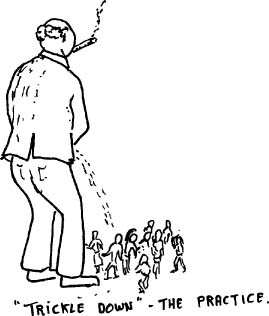
Rich and powerful people are in a position of power, and who doesn't want to be in a better position than everyone else? It's only natural. It does become problematic when the already rich and powerful want to become yet more rich and powerful just for the sake of having more. They might generate wealth that does "trickle down," but at what cost? Overall wealth goes up, but proportionally more goes to the people upstream while the people downstream get the trickles. According to one statistic, 40% of growth in GDP ends up in the hands of the richest 1% of the people. That's just absurd.

The funny thing is that people are amazingly adaptable, especially when it comes to matters of material wealth. We can adjust to our level of financial riches. Once we get past our basic needs, what makes us most happier is not our absolute level of wealth. Rather, it's how well we're doing relative to our peers. Most people would rather be making a moderate salary that's better than their peers than a fortune that's smaller than their peers. It's petty, but the proverbial "keeping up with the Joneses" is firmly ingrained in our psyches.

Which brings me back to trickle down. If the rich get a whole lot richer, while the poor do just a little bit better, then are we really better off?  The people getting a smaller slice of the pie aren't completely clueless.  They can see they're getting shafted.  Even dogs have a sense of fairness.  Humans live longer and, with supposedly more brain power, can devote more neurons to resentment against getting the table scraps with the feast in plain view.  Trickle down economics is merely a way the haves to make themselves feel good about being greedy and taking advantage of the have-nots.


Thursday, May 28, 2009

Camel Jumping

Heh, when I first read about camel jumping (via RossTraining), I thought to myself "I didn't know camels could jump."  Of course, it's not the camels doing the jumping in this case.


I'm sure I could come up with some smart ass comment about the sport, but at the moment, I'm too impressed that the guy had enough hang time to clear six camels.  Ok, maybe I can think of just a couple of humorous (dumb) comments:  I just don't have enough in me to make it over the hump.  That sort of physical exertion might make me yak.

All right, I'm going to leave my comments at that.  I'm seriously impressed at this somewhat unconventional display of athleticism.

Saturday, May 23, 2009

The quick fix

Recently, I read a post on T-nation on training myths.  This mythbuster post made the claim that steroids are overrated and that they don't do nearly as much as most people thinks.  That's an interesting claim, especially coming from a site with a heavy body building slant.  Turns out that I actually agreed with the assessment after I read through the explanation.

Steroids are useful (for the bodybuilder/athlete/etc) for building muscle mass, but there's a big caveat for maximizing the positive effects.  If you're not already working out hard and eating smart, the 'roids probably won't do that much.  It would be akin to putting racing tires on a car with a 4-cylinder engine; the tires may be great, but they don't make up for the fact that the core (engine) of the car sucks.

That got me to thinking about how people are always looking for the quick fix.  There's no substitute for effort.  Even geniuses need to work hard to attain greatness (though it may come easier for them than the average person).  Similar to steroids would be sports supplements IMHO.  They don't do much except fill the coffers of supplement companies unless you're actually training hard enough to need them.

I was talking to one guy in the gym who was asking about which protein shake was the best to take to gain muscle mass.  Fair question (even though not one I'm well equipped to answer being that I don't actually buy those things).  Turns out upon further questioning that he doesn't eat breakfast, eats irregular meals, doesn't even do strength training on a regular schedule, and only does exercises which hit small muscles.  You're just not going to gain any appreciable muscle with poor eating habits, an irregular training schedule, and poor exercise choices.  He shouldn't have even bothered with protein shakes until he took care of the basics.  He totally fell for the quick fix marketing of the protein shake.

My parents shared a Chinese adage with me (which I've heard again from a third party, so I'm confident they weren't making this one up): an idiot who works hard will surpass the lazy genius.  In their own Asian work ethic way were trying to teach me that there's just no substitute for effort.  You can work smarter and find ways to facilitate a process, but in the end there's no quick fix for achieving anything you truly value.

Monday, May 11, 2009

Maintaining Literacy

I've never been a big book reader, except for maybe a brief stint during my middle school years. Being educated and all, I seem to be the exception rather than norm in this regard amongst my peers. Almost everyone I know seems to be more well read than me. Sure, I read plenty of stuff, but it just doesn't tend to be in book format. I'm more likely to be reading articles (online and dead tree), blogs, forums, etc. Maybe it's because I tend to read more of the "how to do stuff" and "how stuff works" sort of things that my fascination with books never quite took off. I find other sources tend to get me the information faster and are usually a little more up to date.

On the other hand, I did marry an English professor. I'm not entirely sure why she agreed to marry me since I must appear nearly illiterate with the dearth of literature in my collection. But I am working on upping my reading rate. My normal book reading average over the past few years was 1-2 books a year. In the past six months, I've managed to read 3: The Four Hour Work Week (Tim Ferriss), The Subtle Knife (Phillip Pullman), and The Omnivore's Dilemma (Michael Pollan). I'm not counting the strength training anatomy book I read since it was mostly pictures, and I'm currently working on The Amber Spyglass (also by Pullman). If I keep up this pace, I'm probably going double or triple my usual reading average.

I'm ambivalent about my new reading habits. I'm usually too busy tackling more projects than I can feasibly handle. I'm enjoying the ability to read at the moment, so I'm hoping that this reading uptick isn't an outlier.